
Skip to main content
Thai Notary Law & Service Co., Ltd. corporate seal logo

Thai Notary Law & Service Co., Ltd.

Reg. No. 0405565001923

Established 2022 · Licensed by Lawyers Council of Thailand

Interpreter services

Court and legal interpreting, English–Thai

Hearings, police interviews, prosecutor appointments and client conferences — prepared from the case file, not improvised on the day.

6
Notary Attorneys
77
Provinces
40+
Languages

Our Team

Click to view full image

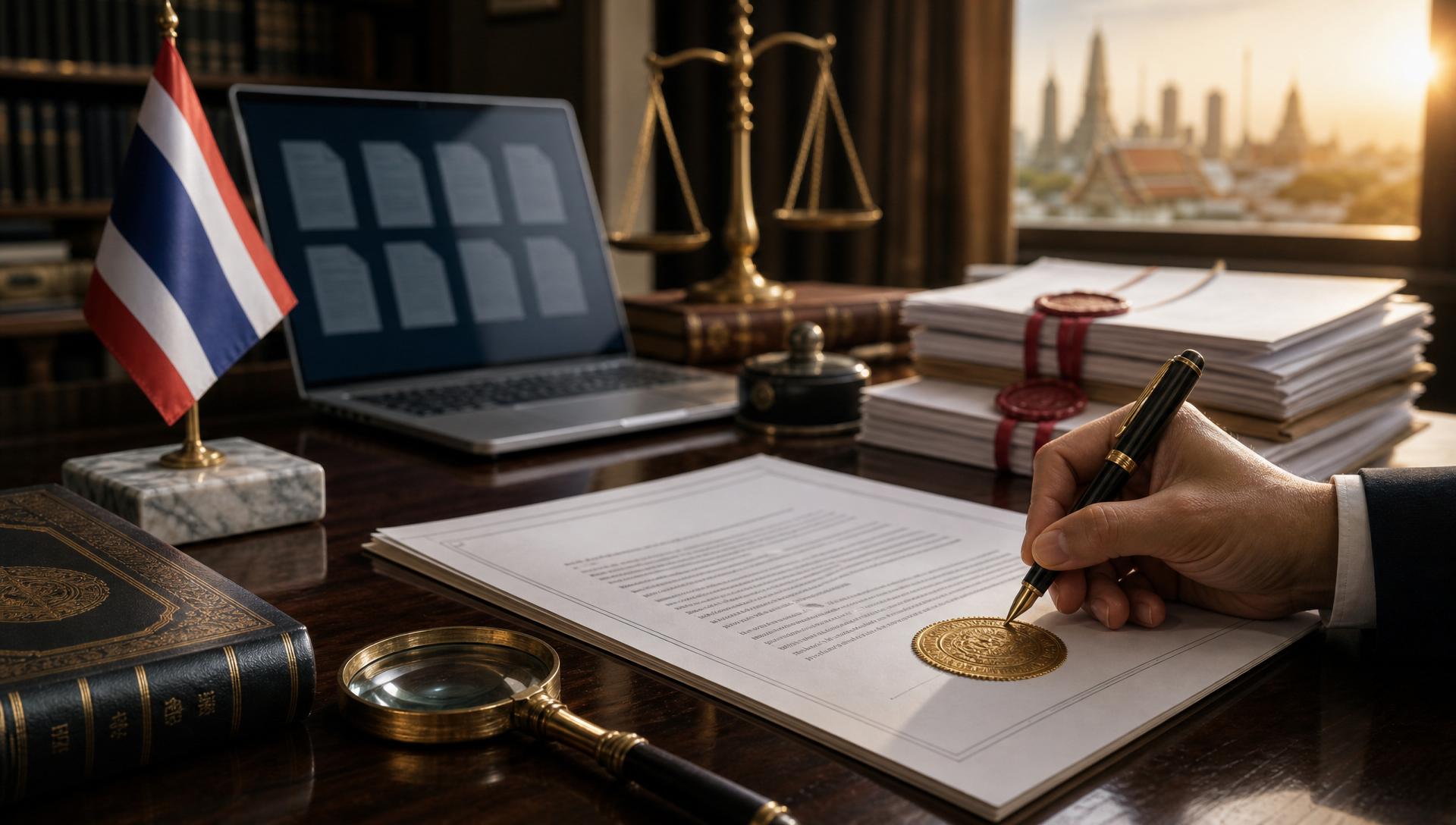
Thai notary attorney affixing a gold notarial seal on a certified document — Bangkok law office at golden hour

Signature Craft

Every notarial seal, every certified translation, every embassy legalization — handled with the precision of a Bangkok law firm licensed since 2022.

In-house Notarial Services Attorneys

Verified Business Registration

Verified by

DBD · กรมพัฒน์ฯ

🏛

Established

2022

🌐

Coverage

180+ countries

6 In-house Notary Public Attorneys

Click any license to view the full image. All 6 attorneys are registered Notarial Services Attorneys under the Lawyers Council of Thailand.

Thai is the language of the courts. Under Criminal Procedure Code s.13, where a party, witness or accused does not understand Thai an interpreter must be provided. We supply English–Thai interpreters for hearings, police interviews, prosecutor appointments and lawyer conferences, briefed on the file's terminology in advance.

Governing authority / legal basis
Criminal Procedure Code s.13 (interpreter in criminal proceedings); Civil Procedure Code s.46 (Thai as the language of the court, Thai translation required for foreign-language documents)
Turnaround
Book as early as the hearing date is known. Same-week bookings depend on availability; police and prosecutor appointments are often called at short notice and we hold an urgent slot where we can.
Fees
Quoted per assignment once we know the venue, the language pair, the date and the expected duration. Confirm scope and fees with our staff by phone, Line or Email before the booking is held.

What we handle

Court hearings

Courts of First Instance, Appeal and the Supreme Court, in civil, criminal and family matters, including remote hearings where the court permits them.

Police and prosecutor stages

Statement-taking at a police station, bail applications and appointments at the Office of the Attorney General.

Lawyer–client conferences

Case briefings and settlement discussions, where accuracy on figures, dates and admissions matters more than speed.

Document terminology support

A glossary of the case's recurring terms agreed with your lawyer before the date, so the same Thai term is used consistently on the record.

Documents required

DocumentIssued / prepared byWatch out for
Case number and court / stationClient or counselThe venue determines travel, the security procedure and the interpreter we assign.
Hearing date, time and expected durationCourtThai courts commonly list several matters in one session; expect waiting time and book the slot accordingly.
Key filings or charge sheetCounselSent under confidentiality so terminology is prepared in advance. Without it, technical terms are decided on the spot.
Names and spellings of partiesClientTransliteration of foreign names into Thai must match the documents already on the file.
Passport of the foreign partyClientCourt and station security check identification on entry.

Document lists, official fees and acceptance conditions vary between offices, branches and provinces, and change by notification. Confirm with the receiving authority before you act on this page.

How the process runs

  1. 1

    Scope confirmed

    We take the venue, date, language pair, subject matter and expected duration, then confirm availability in writing.

    Step 1: Scope confirmed
  2. 2

    File review and glossary

    The assigned interpreter reads the filings you send and returns a glossary of the recurring terms for your lawyer to approve.

    Step 2: File review and glossary
  3. 3

    Attendance

    The interpreter attends, reports to the court officer and interprets consecutively, or whispers for the party where the court allows it.

    Step 3: Attendance
  4. 4

    Follow-up

    You receive an attendance record. Where the court orders further Thai translations of exhibits, we quote that separately as certified translation.

    Step 4: Follow-up

Why files get rejected

  • Some courts appoint their own interpreter. Where they do, our interpreter attends for the foreign party's own understanding, not as the court's officer — clarify the role with your lawyer beforehand.
  • An interpreter does not give legal advice or answer for the party. Instructions must come from your lawyer.
  • Documents in a foreign language filed with a Thai court need a Thai translation; interpreting at the hearing does not satisfy that requirement.
  • Hearings frequently start late or are adjourned. Budget the day rather than the listed hour.
  • Recording court proceedings is not permitted without the court's leave; do not assume an audio record will exist.

Frequently asked questions

คำถามที่พบบ่อย (FAQ)

Does a Thai court provide an interpreter free of charge?+

In criminal proceedings the Criminal Procedure Code requires that an interpreter be provided where the person does not understand Thai, and the court may appoint one. Practice varies by court and language, and many foreign parties still engage their own interpreter so they follow everything said in the room, including exchanges not directed at them.

Can the interpreter also translate my documents for filing?+

Written translation is a separate service. Documents filed with a Thai court must be accompanied by a Thai translation, and where the document goes abroad afterwards it may also need certification. We can handle both, quoted separately.

Is a court interpreter in Thailand required to be certified?+

Thailand has no single national court-interpreter certification comparable to Australia's NAATI. Courts assess suitability case by case, which is why we send the interpreter's background and language pair before the date.

Do you interpret at police stations?+

Yes — statement-taking, bail applications and follow-up appointments. Tell us the station and the officer's appointment time; these are often short-notice.

Which languages do you cover?+

English–Thai is the standard pairing. Other pairs are arranged subject to the availability of a qualified interpreter for the venue and subject matter; ask our staff for the specific language.

Authoritative Sources

References & Citations

Official government, legal, and international sources cited throughout this page.

  1. 1

    Office of the Judiciary of Thailand· แหล่งทางการ

    Courts of Justice of Thailand

    www.coj.go.th

  2. 2

    ago.go.th· แหล่งทางการ

    Office of the Attorney General

    www.ago.go.th

  3. 3

    Lawyers Council of Thailand· แหล่งทางการ

    Lawyers Council of Thailand

    www.lawyerscouncil.or.th

ลิงก์ภายนอกเปิดแท็บใหม่ · ใช้ rel="noopener" เพื่อความปลอดภัย · เนื้อหาในแหล่งอ้างอิงเป็นทรัพย์สินของเจ้าของลิขสิทธิ์

General information, not legal advice on your specific matter. We are not a bank, not an insurance broker and not an agent of any state authority, and we do not guarantee any authority's decision.

Talk to us before you file — reply within 24 hours

Tell us your nationality, visa category and the deadline. Our staff confirms the scope and the fee by phone, Line or Email before any work begins.

Explore More

Related Topics & Deep Dives

Hand-picked guides, services, and resources that pair well with this page.

An interpreter's headset and microphone resting on a notepad in a meeting room
Legal interpreting requires terminology prepared in advance and the interpreter's role stated to all parties.

Deep Context and Service Standards

Sourced from the Lawyer Act B.E. 2528 (1985), the Lawyers Council Regulation on Notarial Services Attorneys B.E. 2546 (2003), the Personal Data Protection Act B.E. 2562 (2019), the Hague Apostille Convention of 1961, and official publications of the Department of Consular Affairs (MFA).

Firm Overview and Practice Framework

Thai Notary Service is a full-service Thai law office providing document notarization, certified translation, legalization chain management, and international document consultancy. Our team includes Notarial Services Attorneys licensed by the Lawyers Council of Thailand under the Royal Patronage, and we operate offices in Bangkok, Greater Bangkok, and a partner network in every province across Thailand. We serve individuals, expatriates, cross-border couples, students, corporates, multinationals, and government agencies requiring documents with legal effect both inside Thailand and abroad.

All notarial acts follow the Lawyer Act B.E. 2528 (1985) Section 27 read with the Lawyers Council Regulation on Notarial Services Attorneys B.E. 2546 (2003), the sole legal basis authorizing Thai attorneys to certify documents comparable to a foreign Notary Public. Every attorney on our team has completed the accredited training and examination administered by the Lawyers Council and holds a verifiable registration number searchable on the Lawyers Council public registry.

By choosing a firm that houses Notarial Services Attorneys in-house, clients consolidate a multi-stage legalization chain under one accountable roof: attorney notarization, followed by Ministry of Foreign Affairs (MFA) legalization at the Department of Consular Affairs, followed by embassy or consular legalization for the destination country. Since 21 November 2024 the Kingdom of Thailand has become a party to the Hague Apostille Convention (Convention of 5 October 1961 Abolishing the Requirement of Legalisation for Foreign Public Documents). Documents apostilled in Thailand are now accepted in more than 125 member states without embassy re-legalization, materially reducing turnaround time and cost.

General Information and Firm Framework — Deep Context

The firm operates under an ISO 9001:2015 quality-management framework and enforces data protection consistent with the Personal Data Protection Act B.E. 2562 (2019). All client documents are stored with AES-256 encryption at rest and in transit and are retained for ten years in accordance with lawyer-record obligations under the Lawyer Act.

Our team combines Notarial Services Attorneys, NAATI-certified translators, and legal specialists in intellectual property, taxation, cross-border family law, corporate law, and immigration law, together with a support team dedicated to documentation, translation, and government-agency liaison.

Fees are transparent and disclosed both on the website and in the pre-engagement quote, separating professional fees, government fees, travel disbursements (if any), and other line items. The firm issues VAT invoices and official receipts and accepts payment by bank transfer, credit card, PromptPay, and cash.

Trust Standards — PDPA, SLA, Quality Assurance

On data protection, the firm strictly follows the Personal Data Protection Act B.E. 2562 (2019), Sections 24, 26, and 27 — collecting, using, and disclosing personal data only to the extent necessary for the engagement, disclosing purposes, and obtaining consent from data subjects in advance. Clients retain the right to inspect, obtain a copy, rectify, erase, or withdraw consent at any time through the firm's Data Protection Officer (DPO). For clients in the European Union, processing follows GDPR Article 6 (lawful basis) and Article 46 (Standard Contractual Clauses).

Our Service Level Agreement targets an inquiry response within one hour during business hours (09:00–18:00, Monday to Saturday), attorney appointments within twenty-four hours, standard notarization within one business day (or two to three hours on express service), certified translation within three to five business days per ten A4 pages, MFA legalization within two business days on standard service (one business day express), and embassy legalization typically within three to fifteen business days depending on the mission's own policy.

Every deliverable passes a three-tier quality-assurance chain: (1) the responsible attorney or translator, (2) a Senior Attorney or department head reviewing substance and formatting, (3) a Quality Control desk performing the final pre-delivery check. Any firm-side error is remedied at no additional cost, and if a document is rejected by a government authority due to a firm-side error, we cover the entire re-filing fee.

Contact and Initial Consultation

Initial consultation is complimentary via Line @thainotary or by phone at 094-8958999. The team responds within one hour during business hours. Every inquiry is treated confidentially under the Lawyers Council ethics rules and the Personal Data Protection Act.